By:
Arip Nurahman
Department of Physics
Faculty of Sciences and Mathematics, Indonesia University of Education
and
Follower Open Course Ware at Massachusetts Institute of Technology
Cambridge, USA
Department of Physics
http://web.mit.edu/physics/
http://ocw.mit.edu/OcwWeb/Physics/index.htm
&
Aeronautics and Astronautics Engineering
http://web.mit.edu/aeroastro/www/
http://ocw.mit.edu/OcwWeb/Aeronautics-and-Astronautics/index.htm


Scientist
A scientist, in the broadest sense, refers to any person that engages in a systematic activity to acquire knowledge or an individual that engages in such practices and traditions that are linked to schools of thought or philosophy. In a more restricted sense, scientist refers to individuals who use the scientific method.
The person may be an expert in one or more areas of science.
This article focuses on the more restricted use of the word.
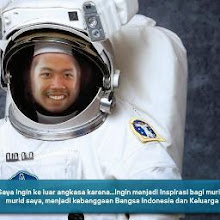
Visi Indonesia Space Scientist Society
Melahirkan Banyak Ilmuwan Antariksa di Indonesia
Misi Indonesia Space Scientist Society
Pendidikan, Penelitian dan Pengembangan IPTEK Antariksa
Program Indonesia Space Scientist Society
Meyebarkan Ilmu Pengetahuan dan Teknologi Antariksa di Indonesia
The person may be an expert in one or more areas of science.
This article focuses on the more restricted use of the word.
Visi Indonesia Space Scientist Society
Melahirkan Banyak Ilmuwan Antariksa di Indonesia
Misi Indonesia Space Scientist Society
Pendidikan, Penelitian dan Pengembangan IPTEK Antariksa
Program Indonesia Space Scientist Society
Meyebarkan Ilmu Pengetahuan dan Teknologi Antariksa di Indonesia
Contents
|
Etymology
Historically, scientists were termed "natural philosophers" or "men of science"; they were men of knowledge. Science and philosophy were roughly synonymous. William Whewell coined the term scientist in 1833 to describe an expert in the study of nature, but this term did not gain wide acceptance until the turn of the 20th century. By the twentieth century, the modern notion of science as a special brand of information about the world, practiced by a distinct group and pursued through a unique method, was essentially in place.
Description
Science and technology have continually modified human existence. As a profession, the scientist of today is widely recognized. Scientists include theoreticians who mainly develop new models to explain existing data and predict new results, and experimentalists who mainly test models by making measurements though in practice the division between these activities is not clear-cut, and many scientists perform both tasks.
Mathematics is often grouped with the sciences. Like other scientists, mathematicians start with hunches (hypotheses) and then conduct symbolic or computational experiments to test them. Some of the greatest physicists have also been creative mathematicians. There is a continuum from the most theoretical to the most empirical scientists with no distinct boundaries. In terms of personality, interests, training and professional activity, there is little difference between applied mathematicians and theoretical physicists.
Scientists can be motivated in several ways. Many have a desire to understand why the world is as we see it and how it came to be. They exhibit a strong curiosity about reality. Other motivations are recognition by their peers and prestige, or the desire to apply scientific knowledge for the benefit of peoples health, the nations, the world, nature or industries. Only few scientists count generating personal wealth as an important driving force behind their science.
Scientists versus Engineers
Engineers and scientists are often confused in the minds of the general public, with the former being closer to applied science. While scientists explore nature in order to discover general principles, engineers apply established principles drawn from mathematics and science in order to develop economical solutions to technical problems.
In short, scientists study things whereas engineers design things. However, there are plenty of instances where significant accomplishments are made in both fields by the same individual. Scientists often perform engineering tasks in designing experimental equipment and building prototypes, and some engineers do first-rate scientific research. Mechanical, electrical, chemical and aerospace engineers are often at the forefront of scientific investigation of new phenomena and materials.
Peter Debye received a degree in electrical engineering and a doctorate in physics before eventually winning a Nobel Prize in chemistry. Similarly, Paul Dirac, one of the founders of quantum mechanics, began his academic career as an electrical engineer before proceeding to mathematics and later theoretical physics. Claude Shannon, a theoretical engineer, founded modern information theory.
In short, scientists study things whereas engineers design things. However, there are plenty of instances where significant accomplishments are made in both fields by the same individual. Scientists often perform engineering tasks in designing experimental equipment and building prototypes, and some engineers do first-rate scientific research. Mechanical, electrical, chemical and aerospace engineers are often at the forefront of scientific investigation of new phenomena and materials.
Peter Debye received a degree in electrical engineering and a doctorate in physics before eventually winning a Nobel Prize in chemistry. Similarly, Paul Dirac, one of the founders of quantum mechanics, began his academic career as an electrical engineer before proceeding to mathematics and later theoretical physics. Claude Shannon, a theoretical engineer, founded modern information theory.
Historical Scientists

Ibn al-Haytham (Alhazen) has been described as the "first scientist" for his development of the scientific method.


An early scientific method which emphasized experimentation was first used by the Iraqi Muslim Arab physicist and polymath Ibn al-Haytham (Alhazen), circa 1021 AD, in his Book of Optics, and he has been described as the "first scientist" for this reason.
There are notable examples of people who have moved back and forth among disciplines. Such polymaths were common during the Islamic Golden Age and European Renaissance. Many of these early polymath scientists were also religious priests and theologians: for example, the polymath scientists Alhazen and al-Biruni were mutakallimiin; the polymath physician Avicenna was a hafiz; the polymath physician Ibn al-Nafis was a hafiz, muhaddith and ulema; the astronomer and physician Nicolaus Copernicus was a priest; and Gregor Mendel, whose discoveries on inheritance founded modern genetics and provides a mechanism to explain Charles Darwin's observations about evolution, was also a priest.
Descartes was not only a pioneer of analytic geometry but formulated a theory of mechanics and advanced ideas about the origins of animal movement and perception. Vision interested the physicists Young and Helmholtz, who also studied optics, hearing and music. Newton extended Descartes' mathematics by inventing calculus (contemporaneously with Leibniz).
He provided a comprehensive formulation of classical mechanics and investigated light and optics. Fourier founded a new branch of mathematics infinite, periodic series studied heat flow and infrared radiation, and discovered the greenhouse effect. Von Neumann, Turing, Khinchin, Markov and Wiener, all mathematicians, made major contributions to science and probability theory, including the ideas behind computers, and some of the foundations of statistical mechanics and quantum mechanics. Many mathematically inclined scientists, including Galileo, were also musicians.
He provided a comprehensive formulation of classical mechanics and investigated light and optics. Fourier founded a new branch of mathematics infinite, periodic series studied heat flow and infrared radiation, and discovered the greenhouse effect. Von Neumann, Turing, Khinchin, Markov and Wiener, all mathematicians, made major contributions to science and probability theory, including the ideas behind computers, and some of the foundations of statistical mechanics and quantum mechanics. Many mathematically inclined scientists, including Galileo, were also musicians.
In the late 19th century, Louis Pasteur, an organic chemist, discovered that microorganisms can cause disease. A few years earlier, Oliver Wendell Holmes, Sr., the American physician, poet and essayist, noted that sepsis in women following childbirth was spread by the hands of doctors and nurses, four years before Semmelweis in Europe. There are many compelling stories in medicine and biology, such as the development of ideas about the circulation of blood from Galen to Harvey. The flowering of genetics and molecular biology in the 20th century is replete with famous names. Ramón y Cajal won the Nobel Prize in 1906 for his remarkable observations in neuroanatomy.
Some see a dichotomy between experimental sciences and purely "observational" sciences such as astronomy, meteorology, oceanography and seismology. But astronomers have done basic research in optics, developed charge-coupled devices, and in recent decades have sent space probes to study other planets in addition to using the Hubble Telescope to probe the origins of the Universe some 14 billion years ago. Microwave spectroscopy has now identified dozens of organic molecules in interstellar space, requiring laboratory experimentation and computer simulation to confirm the observational data and starting a new branch of chemistry. Computer modeling and numerical methods are techniques required of students in every field of quantitative science.
Those considering science as a career often look to the frontiers. These include cosmology and biology, especially molecular biology and the human genome project. Other areas of active research include the exploration of matter at the scale of elementary particles as described by high-energy physics, and nanotechnology, which hopes to develop electronics including microscopic computers, and perhaps artificial intelligence. Although there have been remarkable discoveries with regard to brain function and neurotransmitters, the nature of the mind and human thought still remain.
Types of scientists
- Archeologists
- Astronomers
- astrophysicists
- Biologists
- astrobiologists, botanists, entomologists, evolutionary biologists, ecologists, geneticists, herpetologists, ichthyologists, immunologists, lepidopterists, microbiologists, neuroscientists, ornithologists, paleontologists, pathologists, pharmacologists, physiologists, and zoologists
- Chemists
- biochemists
- Computer scientists
- Earth scientists
- geologists, mineralogists, seismologists, volcanologists, hydrologists, glaciologists, limnologists, meteorologists, and oceanographers
- Management scientists
- Mathematicians
- Medical scientists
- Military scientists
- Physicists
- Philosophers
- Psychologists
- Social scientists
- anthropologists, demographers, economists, geographers, political economists, political scientists, and sociologists
- Technological and agricultural scientists
See also
- Dude scientist
- Fields Medal
- Hippocratic Oath for Scientists
- History of science (and the History of science category)
- Lay people
- Mad scientist
- Natural science
- Nobel Prize
- Protoscience
- Pseudoscience
- Social science
- Women in science
Related lists
References
- ^ Isaac Newton (1687, 1713, 1726). "[4] Rules for the study of natural philosophy", Philosophiae Naturalis Principia Mathematica, Third edition. The General Scholium containing the 4 rules follows Book 3, The System of the World. Reprinted on pages 794-796 of I. Bernard Cohen and Anne Whitman's 1999 translation, University of California Press ISBN 0-520-08817-4, 974 pages.
- ^ Oxford English Dictionary, 2nd ed. 1989
- ^ Nineteenth-Century Attitudes: Men of Science. http://www.rpi.edu/~rosss2/book.html
- ^ Friedrich Ueberweg, History of Philosophy: From Thales to the Present Time. C. Scribner's sons v.1, 1887
- ^ Steve Fuller, Kuhn VS. Popper: The Struggle For The Soul Of Science. Columbia University Press 2004. Page 43. ISBN 0231134282
- ^ Science by American Association for the Advancement of Science, 1917. v.45 1917 Jan-Jun. Page 274.
- ^ "William Whewell (1794-1866) gentleman of science". Retrieved on 2007-05-19.
- ^ Tamara Preaud, Derek E. Ostergard, The Sèvres Porcelain Manufactory. Yale University Press 1997. 416 pages. ISBN 0300073380 Page 36.
- ^ National Society of Professional Engineers (2006). "Frequently Asked Questions About Engineering". Retrieved on 2006-09-21. Science is knowledge based on observed facts and tested truths arranged in an orderly system that can be validated and communicated to other people. Engineering is the creative application of scientific principles used to plan, build, direct, guide, manage, or work on systems to maintain and improve our daily lives.
- ^ Bureau of Labor Statistics, U.S. Department of Labor (2006). "Engineers". Occupational Outlook Handbook, 2006-07 Edition. Retrieved on 2006-09-21.
- ^ Bradley Steffens (2006). Ibn al-Haytham: First Scientist, Morgan Reynolds Publishing, ISBN 1599350246.
External articles
- Further reading
- Alison Gopnik, "Finding Our Inner Scientist", Daedalus, Winter 2004.
- Charles George Herbermann, The Catholic Encyclopedia. Science and the Church. The Encyclopedia press, 1913. v.13. Page 598.
- Thomas Kuhn, The Structure of Scientific Revolutions, 1962.
- Arthur Jack Meadows. The Victorian Scientist: The Growth of a Profession, 2004. ISBN 0712308946.
- Science, The Relation of Pure Science to Industrial Research. American Association for the Advancement of Science. Page 511 onwards.
- Websites
- The philosophy of the inductive sciences, founded upon their history (1847)- Complete Text
- Who was the greatest scientist ever? - Cafe Intellect
- For best results, add a little inspiration - The Telegraph about What Inspired You?, a survey of key thinkers in science, technology and medicine
- Peer Review Journal Science on amateur scientists
- World Social Forum Sciences et dDémocratie