Thursday, 1 July 2010

Astrofisika


"Terkadang Kita merasa hanya berada pada satu ruang dan waktu tanpa menyadari mungkin ada ruang dan waktu serta semesta lain yang ada selain apa yang kita rasakan saat ini" 
~Arip Nurahman~ 


Bagian Terakhir Perkuliahan Astrofisika

Frontiers and Controversies in Astrophysics

Lecture 24 - The Multiverse and Theories of Everything


verview:


Professor Bailyn begins the class with a discussion of a recent New York Times article about the discovery of a new, earth-like planet. He then discusses concepts such as epicycles, dark energy and dark matter; imaginary ideas invented to explain 96% of the universe. The Anthropic Principle is introduced and the possibility of the multiverse is addressed. Finally, biological arguments are put forth for how complexity occurs on a cosmological scale. The lecture and course conclude with a discussion on the fine differences between science and philosophy.

Problem sets/Reading assignment:


Course Media

Transcript

html

Audio

mp3

Low Bandwidth Video

mov [100MB]

High Bandwidth Video

mov [500MB]

Resources:


Sumber:

1. The University of Yale Open Course Ware

2.
Professor Bailyn Websites

http://www.astro.yale.edu/bailyn/
http://www.astro.yale.edu/


Ucapan Terima Kasih:

1. Bapak. Prof. Dr. Ing. H. B. J. Habibie.

2. Departemen Pendidikan Nasional

3. Kementrian Riset dan Teknologi

4. Lembaga Penerbangan dan Antariksa Nasional


Disusun Ulang Oleh:

Arip Nurahman

Department of Physics, Indonesia University of Education

&

Follower Open Course Ware at MIT-Harvard University, Cambridge.USA.

Semoga Bermanfaat dan Terima Kasih

Wednesday, 23 June 2010

Sekolah Pendidikan Robotika Indonesia


(Penulis yang sebelah kanan cie.,.,cie.,.yang Gondrong dikit he.,,.,.he.,,.^_~)

Sekolah Pendidikan Robotika Indonesia


Indonesian Robotics Education School

Visi


Melahirkan Ahli-ahli Robotika Bertaraf Internasional yang senantiasa Bertafakur, Bertasyakur dan Bertadabur terhadap Keagungan Yang Maha Kuasa


Misi

1. Melahirkan Ahli Robotika Berkualitas Internasional Berkarakteristik Lokal di tiap Kabupaten atau Kota Setiap Tahun Minimal 2 Orang.


2. Kaderisasi yang berkelanjutan dan terarah


Program


1. Mempelajari alat-alat elektronika sederhana di Sekeliling Kehidupan kita


2. Mempelajari bahasa-bahasa pemrograman komputer dengan tekun dan rajin


3. Mengembangkan kurikulum pendidikan Robotika


Langkah Setrategis Sederhana


1. Promosi Kesekolah-sekolah Kejuruan dan Menengah atas untuk membuat club-club kecil penggemar Otomasi, Kendali dan Robotika


2. Mengadakan Ivent-ivent kecil dan sederhana megenai Robotika


3. Istiqomah

Saturday, 19 June 2010

Asian & African Nuclear Astrophysics Institute

Vision

The origin and fate of matter in our universe are the fundamental questions in nuclear astrophysics

Mission

To Applied Nuclear Sciences and Technology for Enriched Human Being

Programs

1. Research


2. Innovation


3. Development


4. Education


Focus

1. Energy

2. Application & Engineering

(President Sukarno, Pada Saat Pembukaan Konprensi Asia-Afrika di Bandung)


(President Sukarno, Pada saat Peresmian Reaktor Penelitian BATAN, di Bandung)

 (Peneliti Muda dan Temannya sedang berfoto dengan MAKET reaktor Penelitian Nuklir BATAN)
Asia & Africa Nuclear Energy Association
(Community for Building Nuclear Reactor in Asia & Africa Continent)

Components

The key components common to most types of nuclear power plants are:


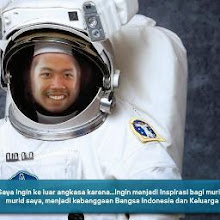
(Penulis sedang "Nyengirrr" he.,he.,, cakep juga ya? Wkwkwk.,.(Readers: "Kepedean tuh mas"))


Nuclear power is produced by controlled (i.e., non-explosive) nuclear reactions. Commercial and utility plants currently use nuclear fission reactions to heat water to produce steam, which is then used to generate electricity. In 2009, 13-14% of the world's electricity came from nuclear power.[1] Also, more than 150 naval vessels using nuclear propulsion have been built.


 (Mr. Angga Fuja W.)

The economics of new nuclear power plants is a controversial subject, since there are diverging views on this topic, and multi-billion dollar investments ride on the choice of an energy source. Nuclear power plants typically have high capital costs for building the plant, but low fuel costs. Therefore, comparison with other power generation methods is strongly dependent on assumptions about construction timescales and capital financing for nuclear plants. Cost estimates also need to take into account plant decommissioning and nuclear waste storage costs. On the other hand measures to mitigate global warming, such as a carbon tax or carbon emissions trading, may favor the economics of nuclear power.