Showing posts with label Indonesian Space Sciences Technology School. Show all posts

Saturday, 6 July 2013

Memupuk Kerjasama IPTEK Antariksa Antar Bangsa


The International Space Station program is tied together by a complex set of legal, political and financial agreements between the fifteen nations involved in the project, governing ownership of the various components, rights to crewing and utilisation, and responsibilities for crew rotation and station resupply.

These agreements tie together the five space agencies and their respective International Space Station Programs and govern how they interact with each other on a daily basis to maintain station operations, from traffic control of spacecraft to and from the station, to utilization of space and crew time.  

See also

The International Space Station (ISS) is a habitable artificial satellite in low Earth orbit. It follows the Salyut, Almaz, Skylab and Mir stations as the ninth space station to be inhabited. The ISS is a modular structure whose first component was launched in 1998. Now the largest artificial body in orbit, it can often be seen at the appropriate time with the naked eye from Earth. The ISS consists of pressurised modules, external trusses, solar arrays and other components. ISS components have been launched by American Space Shuttles as well as Russian Proton and Soyuz rockets.

The ISS serves as a microgravity and space environment research laboratory in which crew members conduct experiments in biology, human biology, physics, astronomy, meteorology and other fields. The station is suited for the testing of spacecraft systems and equipment required for missions to the Moon and Mars


Swiss-cheese model of the cosmos is full of holes

Swiss-cheese model of the cosmos is full of holes

Last year, a team suggested that if the universe was populated by giant voids, it would do away with the need for dark energy, but now that seems unlikely
The ISS programme is a joint project among five participating space agencies: NASA, the Russian Federal Space Agency, JAXA, ESA, and CSA. The ownership and use of the space station is established by intergovernmental treaties and agreements. The station is divided into two sections, the Russian orbital segment (ROS) and the United States orbital segment (USOS), which is shared by many nations. The ISS is maintained at an orbital altitude of between 330 km (205 mi) and 435 km (270 mi). It completes 15.7 orbits per day. 

The ISS is funded until 2020, and may operate until 2028. The Russian Federal Space Agency (RSA/RKA) has proposed using ISS to commission modules for a new space station, called OPSEK, before the remainder of the ISS is de-orbited.


The Station simplifies individual experiments by eliminating the need for separate rocket launches and research staff. The primary fields of research include Astrobiology, astronomy, human research including space medicine and life sciences, physical sciences, materials science, space weather and weather on Earth (meteorology). 

Scientists on Earth have access to the crew's data and can modify experiments or launch new ones, benefits generally unavailable on unmanned spacecraft. 

Crews fly expeditions of several months duration, providing approximately 160 man-hours a week of labour with a crew of 6.

Sumber:

NASA
Wikipedia

Monday, 17 June 2013

Bagaimana Mengembangkan Eksplorasi Antariksa?

"The moon is the first milestone on the road to the stars." 
*Arthur C. Clarke*

Welcome to the Space Exploration Web Site. 

This site is a concise yet comprehensive overview of the immense and expanding field of space exploration. Providing a combination of historical and functional information, this survey should unravel any mysteries that may impede your understanding of space exploration.


With this site, you should be able to find answers to a large array of questions, such as:

Who was the first man in space?

What is the most powerful rocket?

What makes a rocket scientist?

What was the purpose of the Galileo program?

Are we alone in the universe?

Feel free to surf this site for your interests, and I am sure if you do not have any now, you will find some.

Now enjoy!


Space Exploration Timeline

Rockets

How Space is Explored

Biographies

Issues on Space Exploration
About this Page
Bibliography


"Penjelajahan, Eksplorasi Antariksa akan membuka jalan baru bagi IPTEK Maju di masa depan"
*A.N*


On to Space Exploration Home Page On to Rocket Equations Page On to Stargazing Home Page
http://www.rocketmime.com/space/space.html
  1. Tell the purpose of space exploration and include the following:
    1. Historical reason
    2. Immediate goals in terms of specific knowledge
    3. Benefits related to Earth resources, technology, and new products
    Go To Reasons for Space Exploration
  2. Design a collector's card, with a picture on the front and information on the back, about your favorite space pioneer. Share your card and discuss four other space pioneers with your counselor.
    Go To Pioneers of Space Travel
    Go To History of Space Exploration
    Go To Time Line of Space Exploration
    Go To NASA History Page for Human Space Flight
  3. Build, launch, and recover a model rocket. Make a second launch to accomplish a specific objective. (Rocket must be built to meet the safety code of the National Association of Rocketry.) Identify and explain the following rocket parts.
    1. Body tube
    2. Engine mount
    3. Fins
    4. Igniter
    5. Launch lug
    6. Nose cone
    7. Payload
    8. Recovery system
    9. Rocket Engine
    Go To The Flight of the Rocket
    Go To Model Rocket Assembly
    Go To National Association of Rocketry: Model & High Power Rocketry
    Go To NAR -- Model Rocket Safety Code
    Go To Altitude Estimation
    Go To Rocket Launch Checklists
    Go To Glossary of Model Rocketry
  4. Discuss and demonstrate each of the following:
    1. The law of action-reaction
    2. How rocket engines work
    3. How satellites stay in orbit
    4. How satellite pictures of the Earth and pictures of other planets are made and transmitted
    Go To Newton's Laws
    Go To Rocket Propulsion
    Go To How Orbits Work
    Go To How Fast Is Fast?
    Go To Satellite Pictures
  5. Do TWO of the following:
    1. Discuss with your counselor an unmanned space exploration mission and an early manned mission. Tell about each mission's major discoveries, its importance, and what we learned from it about the planets, moons, or regions of space explored.
    2. Using magazine photographs, news clippings, and electronic articles (such as from the Internet), make a scrapbook about a current planetary mission.
    3. Design an unmanned mission to another planet or moon that will return samples of its surface to Earth. Name the planet or moon your spacecraft will visit. Show how your design will cope with the conditions of the planet's or moon's environment.
    Go To JPL Missions unmanned Missions reference
    Go To NASA History Page for Human Space Flight
    Go To The Project Apollo Archive reference on the Apollo moon missions
    Go To Views of the Solar System
    Go To How to Design Your Spacecraft
  6. Describe the purpose and operation of ONE of the following:
    1. Space Shuttle
    2. International Space Station
    Go To Space Shuttle
    Go To Shuttle Flights to Date
    Go To International Space Station Diagrams
    Go To NASA's International Space Station Home Page
  7. Design an inhabited base on the Moon or Mars. Make drawings or a model of your base. In your design, consider and plan for the following:
    1. Source of energy
    2. How it will be constructed
    3. Life-support system
    4. Purpose and function
    Go To How to Design Your Spacecraft
    Go To NASA's Vision for Space Exploration for plans for lunar bases.
    Go To The Case for Mars to find plans for Martian bases.
  8. Discuss with your counselor two possible careers in space exploration that interest you. Find out the qualifications, education, and preparation required and discuss the major responsibilities of those positions.
    Go To NASA Careers
  9.  Stargazing Astronomy Tour of the Night Sky.


    NASA Kids' Club

"We go into space because whatever mankind must undertake, free men must fully share."
*Almarhum President John F. Kennedy*


Lihat Juga:

Indonesian Space Sciences & Technology School

Indonesian University Space Research Association

Semoga Bermanfaat.

Maju Terus IPTEK Antariksa Tanah Air.

Tuesday, 21 May 2013

Bisakah Kita Melampaui Kecepatan Cahaya?

Star Trek Into Darkness - Michael Giacchino - 21st Century Symphony Orchestra & Chorus


Di tahun 1905, Prof. Albert Einstein dalam rumus Relativitas Khususnya yang terkenal, menyatakan bahwa kecepatan cahaya (c) selalu konstan, dan berbeda dengan hal lainnya, kecepatan cahaya tidak relatif.
Dan Einstein juga menyebutkan bahwa tidak mungkin ada sesuatupun di alam semesta, yang bisa melebihi kecepatan cahaya.
Tidak mungkin, impossible. 
Dan ini membuat perjalanan luar angkasa akan menjadi "kurang" efisien. Tapi di tahun 1994, seseorang saintis menyatakan bahwa kecepatan melebihi kecepatan cahaya dimungkinkan secara teoritis.
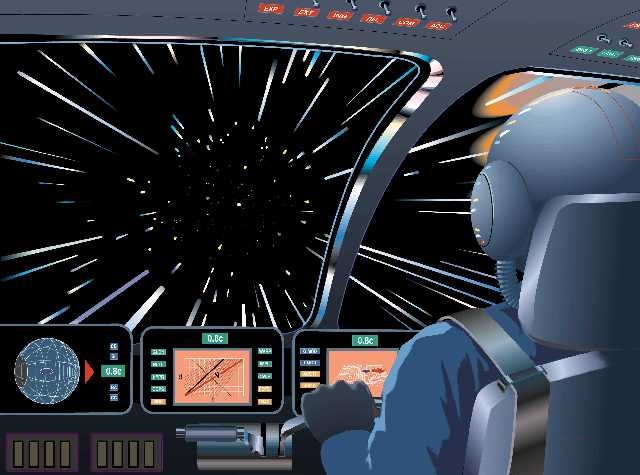
Caranya adalah dengan menggunakan Warp Drive Engine, mesin yang mempunyai kemampuan ”melengkungkan Ruang-Waktu”, Space-Time Bubble.


Nama saintis itu adalah: Dr. Miguel Alcubierre.


Beliau adalah Director of the Nuclear Sciences Institute at the National Autonomous University of Mexico (UNAM)

He receiving his doctorate through study of numerical general relativity. After 1996 he worked at the Max Planck Institute for Gravitational Physics in Potsdam, Germany, developing new numerical techniques used in the description of black holes.

Since 2002, he has worked at the Nuclear Sciences Institute of the National Autonomous University of Mexico (UNAM), where he conducts research in numerical relativity, employing computers to formulate and solve the physical equations first proposed by Albert Einstein.

The solitary wave solutions proposed by Alcubierre for the Einsteinian field equations may possibly prove general relativity consistent with the experimentally verified non-locality of quantum mechanics. This work militates against the idea that quantum non-locality would ultimately require abandoning the mathematical structure of general relativity.


(Alcubierre Drive, The Warp Drive: Hyper-fast travel within general relativity, 1994 dalam jurnal Classical and Quantum Gravity)


The Physics and Mathematics of the Alcubierre Drive 

Using the ADM formalism of general relativity, the spacetime is described by a foliation of space-like hypersurfaces of constant coordinate time t. The general form of the metric described within the context of this formalism is:

ds^2 = -\left(\alpha^2- \beta_i \beta^i\right)\,dt^2+2 \beta_i \,dx^i\, dt+ \gamma_{ij}\,dx^i\,dx^j
where
\alpha is the lapse function that gives the interval of proper time between nearby hypersurfaces,
\beta^i is the shift vector that relates the spatial coordinate systems on different hypersurfaces, and
\gamma_{ij} is a positive definite metric on each of the hypersurfaces.
The particular form that Alcubierre studied is defined by:
\alpha=1\,
\beta^x=-v_s(t)f\left(r_s(t)\right)
\beta^y = \beta^z =0 \,\!
\gamma_{ij}=\delta_{ij} \,\!
where
v_s(t)=\frac{dx_s(t)}{dt},
r_s(t)=\sqrt{(x-x_s(t))^2+y^2+z^2},
and
f(r_s)=\frac{\tanh(\sigma (r_s + R))-\tanh(\sigma (r_s - R))}{2 \tanh(\sigma R)},
with arbitrary parameters R > 0 and \sigma > 0. Alcubierre's specific form of the metric can thus be written
ds^2 =  \left(v_s(t)^2 f(r_s(t))^2 -1\right)\,dt^2 - 2v_s(t)f(r_s(t))\,dx\,dt +dx^2 + dy^2 + dz^2.
With this particular form of the metric, it can be shown that the energy density measured by observers whose 4-velocity is normal to the hypersurfaces is given by
-\frac{c^4}{8 \pi G} \frac{v_s^2 (y^2+z^2)}{4 g^2 r_s ^2} \left(\frac{df}{dr_s}\right)^2,
where  g\! is the determinant of the metric tensor.
Thus, as the energy density is negative, one needs exotic matter to travel faster than the speed of light. The existence of exotic matter is not theoretically ruled out; however, generating and sustaining enough exotic matter to perform feats such as faster-than-light travel (and also to keep open the 'throat' of a wormhole) is thought to be impractical. Low has argued that within the context of general relativity, it is impossible to construct a warp drive in the absence of exotic matter.

Kelajuan cahaya (kelajuan cahaya dalam ruang vakum; kecepatan cahaya) adalah sebuah konstanta fisika yang disimbolkan dengan huruf c, singkatan dari celeritas (yang dirujuk dari dari bahasa Latin) yang berarti "kecepatan". Konstanta ini sangat penting dalam fisika dan bernilai 299.792.458 meter per detik.

Nilai ini merupakan nilai eksak disebabkan oleh panjang meter didefinisikan berdasarkan konstanta kelajuan cahaya. Kelajuan ini merupakan kelajuan maksimum yang dapat dilajui oleh segala bentuk energi, materi, dan informasi dalam alam semesta.

Kelajuan ini merupakan kelajuan segala partikel tak bermassa dan medan fisika, termasuk radiasi elektromagnetik dalam vakum. Kelajuan ini pula menurut teori modern adalah kelajuan gravitasi (kelajuan dari gelombang gravitasi).

Partikel-partikel maupun gelombang-gelombang ini bergerak pada kelajuan c tanpa tergantung pada sumber gerak maupun kerangka acuan inersial pengamat. Dalam teori relativitas, c saling berkaitan dengan ruang dan waktu. Konstanta ini muncul pula pada persamaan fisika kesetaraan massa-energi E = mc2

Warp = c (kecepatan cahaya) Pangkat 3

Warp 1 = 1 Kali c

Warp 2 = 8 kali c

Warp 3 = 27 kali c

Warp 5 = 125 kali c

Ini adalah daftar dari kecepatan Warp:

1. Full Impulse: 270 juta km/h

2. Warp 1: 1 miliar km/h

3. Warp 2: 11 miliar km/h

4. Warp 3: 42 miliar km/h

5. Warp 4: 109 miliar km/h

6. Warp 5: 229 miliar km/h

7. Warp 6: 421 miliar km/h

8. Warp 7: 703 miliar km/h

9. Warp 8: 1.1 triliun km/h

10. Warp 9: 1.62 triliun km/h

11. Warp 10: Tak Terbatas


Warp field dynamics monitor

Seandainya ini menjadi kenyataan, maka perjalanan menuju bintang-bintang akan dimungkinkan, dan planet-planet terjauh dan asing di tata surya pun bisa dicapai, hanya dalam hitungan menit.

Dan impian manusia yang telah ada selama ribuan tahun, untuk mengetahui apa yang ada di angkasa luar sana, akan terwujud.

Impian ini mulai menjadi populer di dunia sejak sebuah epik fiksi ilmiah ditayangkan di tahun 1966.

Kisah petualangan pesawat ruang angkasa Star Trek.

Wallohualam Bissawab