Sunday, 18 June 2006

Fisika SMA

Pengalaman Belajar Fisika di SMAN BI 1 Banjar

Ada Apa Dengan Fisika?

Pascal's Principle and Hydraulics


SUBJECT: Physics
TOPIC: Hydraulics
DESCRIPTION: A set of mathematics problems dealing with hydraulics.
CONTRIBUTED BY: Carol Hodanbosi
EDITED BY: Jonathan G. Fairman - August 1996

Hydraulic systems use a incompressible fluid, such as oil or water, to transmit forces from one location to another within the fluid. Most aircraft use hydraulics in the braking systems and landing gear. Pneumatic systems use compressible fluid, such as air, in their operation. Some aircraft utilize pneumatic systems for their brakes, landing gear and movement of flaps.
Pascal's law states that when there is an increase in pressure at any point in a confined fluid, there is an equal increase at every other point in the container.
A container, as shown below, contains a fluid. There is an increase in pressure as the length of the column of liquid increases, due to the increased mass of the fluid above.
For example, in the figure below, P3 would be the highest value of the three pressure readings, because it has the highest level of fluid above it.
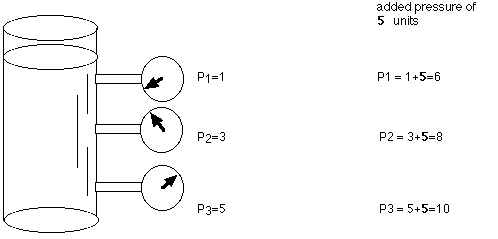

If the above container had an increase in overall pressure, that same added pressure would affect each of the gauges (and the liquid throughout) the same. For example P1, P2, P3 were originally 1, 3, 5 units of pressure, and 5 units of pressure were added to the system, the new readings would be 6, 8, and 10.
Applied to a more complex system below, such as a hydraulic car lift, Pascal's law allows forces to be multiplied. The cylinder on the left shows a cross-section area of 1 square inch, while the cylinder on the right shows a cross-section area of 10 square inches. The cylinder on the left has a weight (force) on 1 pound acting downward on the piston, which lowers the fluid 10 inches. As a result of this force, the piston on the right lifts a 10 pound weight a distance of 1 inch.
The 1 pound load on the 1 square inch area causes an increase in pressure on the fluid in the system. This pressure is distributed equally throughout and acts on every square inch of the 10 square inch area of the large piston. As a result, the larger piston lifts up a 10 pound weight. The larger the cross-section area of the second piston, the larger the mechanical advantage, and the more weight it lifts.
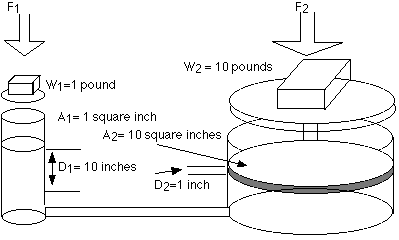

The formulas that relate to this are shown below:
P1 = P2 (since the pressures are equal throughout).
Since pressure equals force per unit area, then it follows that
F1/A1 = F2/A2
It can be shown by substitution that the values shown above are correct,
1 pound / 1 square inches = 10 pounds / 10 square inches
Because the volume of fluid pushed down on the left side equals the volume of fluid that is lifted up on the right side, the following formula is also true.
V1 = V2
by substitution,
A1 D1 = A2 D2
  • A = cross sectional area
  • D = the distance moved
or
A1/A2= D2/D1
This system can be thought of as a simple machine (lever), since force is multiplied.The mechanical advantage can be found by rearranging terms in the above equation to
Mechanical Advantage(IMA) = D1/D2 = A2/A1
For the sample problem above, the IMA would be 10:1 (10 inches/ 1 inch or 10 square inches / 1 square inch).
Given these simple formulas, try to answer the questions below.

Exercises:
  1. A hydraulic press has an input cylinder 1 inch in diameter and an output cylinder 6 inches in diameter.
    1. Assuming 100% efficiency, find the force exerted by the output piston when a force of 10 pounds is applied to the input piston.
      (answer)

    2. If the input piston is moved through 4 inches, how far is the output piston moved?
      (answer)

  2. A hydraulic system is said to have a mechanical advantage of 40. Mechanical advantage (MA) is FR (output) / FE (input). If the input piston, with a 12 inch radius, has a force of 65 pounds pushing downward a distance of 20 inches, find

    1. the volume of fluid that has been displaced
      (answer)

    2. the upward force on the output piston
      (answer)

    3. the radius of the output piston
      (answer)

    4. the distance the output piston moves
      (answer)


  3. What pressure does a 130 pound woman exert on the floor when she balances on one of her heels? Her heels have an average radius of 0.5 inch.
    (answer)

  4. A car has a weight of 2500 pounds and rests on four tires, each having a surface area of contact with the ground of 14 square inches. What is the pressure the ground experiences beneath the tires that is due to the car?
    (answer)

    Extension :
  5. The input and output pistons of a hydraulic jack are respectively 1 cm and 4 cm in diameter. A lever with a mechanical advantage of 6 is used to apply force to the input piston. How much mass can the jack lift if a force of 180 N is applied to the lever and efficiency is 80%?
    (answer)

Sumber:

NASA

Thursday, 18 May 2006

Fisika SMA

Pengalaman Belajar Fisika di SMAN BI 1 Banjar

Buoyancy: Archimedes Principle


SUBJECT: Physics
TOPIC: Buoyancy
DESCRIPTION: A set of mathematics problems dealing with buoyancy.
CONTRIBUTED BY: Carol Hodanbosi
EDITED BY: Jonathan G. Fairman - August 1996

There are two types of flying machines that allow for lift to overcome gravity. The first type, called the aerodynamic machines such as helicopters and airplanes, rely on thrust and forward speed to produce lift. The second type, aerostatic machines, such as hot air balloons and lighter than air-type craft, rely on the differences in air density for lift.
This lesson is concerned with the second type, the type that are dependent on buoyancy.
If a cubic centimeter of aluminum was suspended in a fluid such as water with a very thin and negligible thread, the metal cube would have the fluid exerting pressure on the cube. Try to imagine that if the cube were to disappear, and the fluid would magically replace the cube, then the surrounding water would support this cube that is now containing water, so that the cube of water would be motionless. That is, the forces would be balanced. The cube of water would push out on the surrounding water and the surrounding water would push back on the cube. The fluid would be static, or stationary. Now replace this same cube of water with the original cube of aluminum. The surrounding water would not 'know' that the cube has been replaced with another substance. It would still push inward and upward and downward with the same force that it pushed on the cube of water. The sideways forces would be balanced and oppose each other equally, but the upward and downward forces would not be the same. The pressure at the bottom of the cube is greater than the pressure at the top of the cube, because pressure increases with increased depth. The difference between the upward and downward forces acting on the bottom and the top of the cube, respectively,is called buoyancy.
Using the aluminum as our example, it has a specific gravity of 2.8. Water has a specific gravity of 1.0. This means that a cubic centimeter of water would have a mass of 1.0 grams, while aluminum of the same size would have a mass of 2.8 grams. Since the aluminum cube displaces 1 cubic centimeter of water, it has a buoyancy of 1.0 grams. Since buoyancy is a force and not a mass, it must be converted to the proper units, which when multiplied by the acceleration of gravity (980 cm/s2) gives the units of dynes. That is,
(1.0 grams) (980 cm/s2) = 980 grams cm /s2 or dynes
So our aluminum cube immersed in water would not 'weigh' (2.8 x 980) dynes or 2744 dynes. It would weigh less due to the fact it has a buoyant force of (1 x 980) dynes from the water. So it would weigh (2744-980) dynes or 1764 dynes while immersed in the water.
Archimedes Principle states that the buoyant force on a submerged object is equal to the weight of the fluid that is displaced by the object.
Hot air balloons rise into the air because the density of the air (warmer air) inside the balloon is less dense than the air outside the balloon (cooler air). The balloon and the basket displaces a fluid that is heavier than the balloon and the basket, so it has a buoyant force acting on the system. Balloons tend to fly better in the morning, when the surrounding air is cool.

Exercises:

  1. Find the weight of the air in a room with dimensions of 20 ft x 12 ft x 15 ft. The weight density of air at sea level is 0.08 pounds /ft3.
    (answer)
  2. An iron anchor weighs 250 pounds in air and has a weight density of 480 lbs/ft3. If it is immersed in sea water that has a weight density of 64 lbs/ft3, how much force would be required to lift it while it is immersed?
    (answer)
  3. An aluminum bar weighs 17 pounds in air. How much force is required to lift the bar while it is immersed in gasoline? The weight density of aluminum is 170 pounds /ft3 and that of gasoline is 42 pounds /ft3.
    (answer)
  4. How much does a 20 ft x 10 ft x 8 ft swimming pool filled with water weigh? Assume the water has a weight density of 62 lbs/ft3.
    (answer)
  5. A balloon weighing 80 kg has a capacity of 1200 m3. If it is filled with helium, how great a payload can it support? The density of helium is 0.18 kg/ m3 and the density of air is 1.30 kg/ m3. Express your answer in newtons.
    (answer)
 Sumber:

NASA

Tuesday, 18 April 2006

Fisika SMA

Pengalaman Belajar di SMAN BI 1 Banjar

Ada Apa Dengan Fisika?

Newton's Third Law of Motion


SUBJECT: Physics
TOPIC: Force and Motion
DESCRIPTION: A set of mathematics problems dealing with Newton's Laws of Motion.
CONTRIBUTED BY: Carol Hodanbosi
EDITED BY: Jonathan G. Fairman - August 1996

The third law of motion states that if a body exerts a force on a second body, the second body exerts a force that is equal in magnitude and opposite in direction to the first force. So for every action force there is always a reaction force. No force can occur by itself
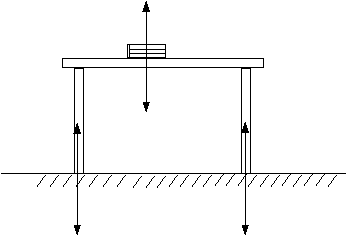
The book lying on the table is exerting a downward force on the table, while the table is exerting an upward reaction force on the book. Because the forces are equal and opposite, the book remains at rest. Notice also that the table legs are in contact with the floor and exert a force downward on it, while the floor in turn exerts an equal and opposite force upward.
Figure showing a book on a table and the force pairs on the

 book and the legs.
Questions for you to consider:

  • If forces are always equal and opposite in action and reaction, how is it possible for an object to accelerate?
    (Answer)

  • Explain, in detail, using the third law of motion, how a person is able to walk forward.
    (Answer)

  • There is a classic problem that physicists like to ask students. A horse is pulling a carriage on a level ground. The horse knows the third law of motion. He tells the carriage that he will exert a force forward, and the carriage will exert a force equal to the horse's force but in opposite directions. Therefore, the horse explained, he can never pull the carriage forward. Can you explain to the horse that he is mistaken? How is he able to pull the carriage forward?
    (Answer)


  • Sumber:

    NASA