Thursday, 29 March 2012

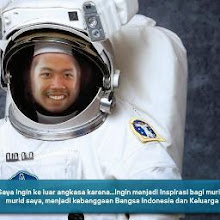
Astrofisikawan Indonesia Johny Setiawan

Allhamdulilah pagi ini penulis dapat bersahabat dengan Sang Ilmuwan Muda Kelahiran Indonesia dalam jejaring sosial Facebook:


Sang Pencari dan Penemu Planet

Dr. rer. nat. Johny Setiawan, Dipl. Phys.

1. http://www.johny-setiawan.net/
2. http://www.mpia.de/Public/menu_q2.php

Date of birth: 1974 August 16th

Place of birth: Jakarta, Indonesia

Nationality (by ethnicity): Indonesian

Citizenship: German

Home addresses: 10365 Berlin, Germany, 69126 Heidelberg, Germany

Bintaro Sektor IX, Tangerang, Banten, Indonesia


Affiliation: Embassy of the Republic of Indonesia, Lehrter Str. 16-17, 10557 Berlin, Germany

Contact: e-mail: setiawan@indonesian-embassy.de

Tel. +49 30 47807 242

Fax. +49 30 44737 142


School

1981-1986: Elementary school

SD. St. Fransiskus I, Jakarta, Indonesia.

1986-1989: Middle school

SMP Immaculata, Marsudirini, Jakarta, Indonesia.

1989-1992: High school

SMA Fons Vitae I, Marsudirini, Jakarta, Indonesia.


University


1992-1993: Preparatory courses for foreign students (University of Heidelberg).

1993-1999: Undergraduate and graduate studies in physics (Diplom) Albert-Ludwig University of Freiburg.

1999-2003: Doctoral program at the Albert-Ludwig University of Freiburg

2009- 2011: Courses in Law and Business at the University of Mannheim

Courses in Politics at the University of Mannheim

Courses in History at the University of Heidelberg


Work experience


1995-2001: Student assistant for administration of the Evangelisches Studentenwohn-Heim
(student residence) in Freiburg.

1997-1999: Cook in the gastronomy.

Apr-Sept 2000: Student research assistant at the European Southern Observatory, Garching bei München.

Sept 2000-May 2003: Research scientist and doctoral candidate at the Kiepenheuer-Institute for Solar Physics, Freiburg.

Jan-June 2001: Student research assistant at Mettler Toledo AG, Schwerzenbach/Zurich (Switzerland )

June 2003- Sept 2011: Research scientist at the Max-Planck Institute for Astronomy (MPIA) in the Department of Planet and Star formation.

Mar 2012-now: Embassy of the Republic of Indonesia in Berlin, Germany. Section for Economic (and Development).


International experience and collaborations


1999 - 2011 regular visitor at the La Silla observatory in Chile for astronomical observations.

2000 - 2011 collaborations with international colleagues from:

• European Southern Observatory (ESO)

• Université de Genève, Observatoire de Genève (Switzerland)

• Universidad Federal do Rio Grande do Norte (Brazil)

• National Astronomical Observatories, Chinese Academy of Sciences, Beijing (China)

• Department of Physics and Kavli Institute of Astrophysics and Space Research, Massachussetts Institute of Technology, Cambridge, USA

2009 - Now : Deputy chairman (Oct 2009- Jul 2011) and Advisory board member (since Sept. 2011) of Ikatan Ilmuwan Indonesia Internasional (I-4, International Indonesian Scholar Association)


Invitation for giving scientific talks


2008:  European Space Agency (the Netherlands), Kiepenheuer Institute for Solar Physics (Freiburg, Germany), University of Hamburg, University of Jena, Asian Science Camp, Bali, Indonesia

2009: Embassy of the Republic of Indonesia for Germany, Berlin, University of Heidelberg

2010: Department of Astronomy ETH, Zürich, Switzerland, Fakultas Matematika dan Ilmu Pengetahuan Alam, ITB, Indonesia

2011: Torun Centre for Astronomy, Poland

2012:  Arecibo Observatory, Puerto Rico OeAD & Embassy of the Republic of Indonesia for Austria, Vienna

Miscellaneous: language skills and hobbies

Language skills: indonesian (native), german (native-speaker level), english (fluent), spanish (good), french (fair)

Computer skills: Windows, Linux, Unix, SAP/R3

Hobbies: Cooking, travelling, fitness, cultural activities, paleontology & archeology, videography.

http://www.i-4.or.id/

Ikatan Ilmuwan Indonesia Internasional


Penemu Tata Surya Tertua

Johny Setiawan, astronom Indonesia, beserta astronom Eropa berhasil menemukan tata surya tertua. Dunia baru tersebut terdiri atas satu bintang yang dikelilingi oleh dua planet. Tata surya tersebut dikatakan tertua karena berumur 12,8 miliar tahun, hanya 900 juta tahun lebih muda dari semesta yang tercipta lewat Big Bang pada 13,7 miliar tahun lalu.

Bintang induk pada tata surya tersebut diberi nama HIP 11952 sesuai penamaan obyek dari katalog Hipparcos. Sementara kedua planet yang mengorbit bintang tersebut diberi nama HIP 11952 b dan HIP 11952 c. HIP 11952 juga dijuluki "Sannatana". Dalam bahasa Sansekerta, kata tersebut berarti abadi atau purba, sesuai dengan keunikan tata surya baru ini.

Sistem keplanetan yang baru saja ditemukan ini diperkirakan terbentuk saat galaksi Bimasakti masih bayi atau bahkan belum terbentuk. Jarak tata surya ini bahkan tak jauh, hanya 375 tahun cahaya dari Bumi. "Ini sama perumpamaannya dengan menemukan benda arkeologi di pekarangan rumah sendiri," ungkap John.

Dua planet yang mengitari HIP 11952 ditemukan dengan metode kecepatan radial. Teknik ini didasarkan pada observasi gerakan bintang induk akibat planet-planet yang mengelilinginya. Penelitian dilakukan pada tahun 2009-2011 menggunakan spektrometer FEROS (Fibre-fed Extended Range Optical Range Spectograph) pada teleskop 2,2 meter di Observatorium La Silla, Cile.

Berdasarkan penelitian, diketahui bahwa dua planet di tata surya baru ini ialah planet gas raksasa berukuran 0,8 dan 2,9 kali Jupiter. Masing-masing berevolusi dengan periode 7 dan 290 hari.

Anomali

Tata surya baru ini bisa dikatakan anomali. Pasalnya, bintang induk pada sistem keplanetan ini miskin logam, diperkirakan hanya 1 persen dari kandungan logam Matahari. Teori saat ini menyatakan bahwa bintang-bintang dengan kandungan logam tinggi cenderung memiliki peluang lebih besar untuk memiliki planet, dan sebaliknya.

Sejauh ini, HIP 11952b dan HIP 11952c adalah temuan planet kedua yang mengelilingi bintang miskin logam. Tahun 2010, ditemukan planet yang mengelilingi HIP 13044 yang juga miskin logam. Berdasarkan hasil penelitian, Johny mengatakan, "Kedua planet yang mengitari HIP 11952 membuktikan bahwa planet-planet ternyata memang dapat terbentuk di sekitar bintang yang kandungan logamnya sedikit."

Tak cuma itu, Johny yang bertahun-tahun bekerja di Max Planck Institute for Astronomy di Heidelberg, Jerman, mengatakan bahwa planet di sekelilling bintang melarat logam mungkin umum. Observasi pada bintang-bintang tua masih diperlukan untuk mengonfirmasi hal tersebut. Tim peneliti masih akan terus mencari jawabannya.

Secara lebih luas, secara teoritis diketahui bahwa lingkungan awal semesta hanya terdiri atas hidrogen dan helium. Unsur-unsur logam yang lebih berat terbentuk lewat proses lebih lanjut seperti supernova. Penelitian ini menunjukkan bahwa manusia bisa berharap adanya planet-planet purba yang terbentuk pada awal semesta, walau kondisinya dipandang kurang memungkinkan.

Hasil penelitian Johny dipublikasikan di jurnal Astronomy and Astrophysics yang terbit minggu ini. Johny kini mengabdi di Kedutaan Besar Republik Indonesia di Berlin.

Sumber:
1.  http://www.mpia.de/Public/menu_q2.php
Max Planck Institute for Astronomy
Königstuhl 17
D-69117 Heidelberg


Phone: (++49|0) 6221 – 528-0
Fax: (++49|0) 6221 – 528-246
E-mail: sekretariat@mpia.de

2. http://www.eso.org/sci/facilities/lasilla/
La Silla Paranal Observatory: La Silla Facilities

3. http://www.aanda.org/
Journal of Astronomy & Astrophysics

4. http://www.indonesian-embassy.de/
Embassy of the Republic of Indonesia in Berlin - Germany

5. Kompas Sains

Monday, 26 March 2012

Unsolved Problems in Physics Part I


“This most beautiful system (The Universe) could only proceed from the dominion of an intelligent and powerful Being.”
~Isaac Newton~

Some of these problems are theoretical, meaning that existing theories seem incapable of explaining a certain observed phenomenon or experimental result. The others are experimental, meaning that there is a difficulty in creating an experiment to test a proposed theory or investigate a phenomenon in greater detail.


Theoretical problems

The following problems are either fundamental theoretical problems, or theoretical ideas which lack experimental evidence and are in search of one, or both, as most of them are. Some of these problems are strongly interrelated.

For example, extra dimensions or supersymmetry may solve the hierarchy problem. It is thought that a full theory of quantum gravity should be capable of answering most of these problems (other than the Island of stability problem).

Quantum gravity, cosmology, and general relativity

Vacuum catastrophe

Why does the predicted mass of the quantum vacuum have little effect on the expansion of the universe?

Quantum gravity

Can quantum mechanics and general relativity be realized as a fully consistent theory (perhaps as a quantum field theory) Is spacetime fundamentally continuous or discrete?

Would a consistent theory involve a force mediated by a hypothetical graviton, or be a product of a discrete structure of spacetime itself (as in loop quantum gravity)?

Are there deviations from the predictions of general relativity at very small or very large scales or in other extreme circumstances that flow from a quantum gravity theory?

Black holes, black hole information paradox, and black hole radiation

Do black holes produce thermal radiation, as expected on theoretical grounds?

Does this radiation contain information about their inner structure, as suggested by Gauge-gravity duality, or not, as implied by Hawking's original calculation?

If not, and black holes can evaporate away, what happens to the information stored in them
(quantum mechanics does not provide for the destruction of information)?

Or does the radiation stop at some point leaving black hole remnants?

Is there another way to probe their internal structure somehow, if such a structure even exists?

Extra dimensions

Does nature have more than four spacetime dimensions?

If so, what is their size?

Are dimensions a fundamental property of the universe or an emergent result of other physical laws?

Can we experimentally "see" evidence of higher spatial dimensions?

Cosmic inflation

Is the theory of cosmic inflation correct, and if so, what are the details of this epoch?

What is the hypothetical inflaton field giving rise to inflation?

If inflation happened at one point, is it self-sustaining through inflation of quantum-mechanical fluctuations, and thus ongoing in some impossibly distant place?

Multiverse


Are there physical reasons to expect other universes that are fundamentally non-observable?
For instance: Are there quantum mechanical "alternative histories" or "many worlds"?

Are there "other" universes with physical laws resulting from alternate ways of breaking the apparent symmetries of physical forces at high energies, possibly incredibly far away due to cosmic inflation?

Is the use of the anthropic principle to resolve global cosmological dilemmas justified?


The cosmic censorship hypothesis and the chronology protection conjecture

Can singularities not hidden behind an event horizon, known as "naked singularities", arise from realistic initial conditions, or is it possible to prove some version of the "cosmic censorship hypothesis" of Roger Penrose which proposes that this is impossible?

Similarly, will the closed timelike curves which arise in some solutions to the equations of general relativity
(and which imply the possibility of backwards time travel) be ruled out by a theory of quantum gravity which unites general relativity with quantum mechanics, as suggested by the "chronology protection conjecture" of Stephen Hawking?

Arrow of time

What do the phenomena that differ going forward and backwards in time tell us about the nature of time?

How does time differ from space?

Why are CP violations observed in certain weak force decays, but not elsewhere?

Are CP violations somehow a product of the Second Law of Thermodynamics, or are they a separate arrow of time?

Are there exceptions to the principle of causality?

Is there a single possible past?

Is the present moment physically distinct from the past and future or is it merely an emergent property of consciousness?

Why do people appear to agree on what the present moment is?

Locality

Are there non-local phenomena in quantum physics?

If they exist, are non-local phenomena limited to the entanglement revealed in the violations of the Bell Inequalities, or can information and conserved quantities also move in a non-local way?

Under what circumstances are non-local phenomena observed?

What does the existence or absence of non-local phenomena imply about the fundamental structure of spacetime?

How does this relate to quantum entanglement? How does this elucidate the proper interpretation of the fundamental nature of quantum physics?


Future of the universe

Is the universe heading towards a Big Freeze, a Big Rip, a Big Crunch or a Big Bounce?

Is our universe part of an infinitely recurring cyclic model?

Sources:

1. Wikipedia
2. List of links to unsolved problems in physics, prizes and research.
3. Ideas Based On What We’d Like to Achieve
4. 2004 SLAC Summer Institute: Nature's Greatest Puzzles

Photo By:
Arip Nurahman

Tuesday, 6 March 2012

GAYA

Gaya-gaya di Alam


"Jika kita bergetar dan tertarik oleh seseorang percayalah itu bukan Gravitasi"
-Arip-

Gaya-gaya fundamental

Berbagai macam gaya yang diamati di alam dapat dijelaskan lewat 4 interaksi dasar yang terjadi antara partikel-partikel elementer:

1. Gaya gravitasi
2. Gaya elektromagnetik
3. Gaya nuklir kuat (juga dinamakan gaya hadronik)
4. Gaya nuklir lemah


Gaya gravitasi antara bumi dan sebuah benda di dekat permukaan bumi adalah berat benda.

Gaya gravitasi yang dikerjakan oleh Matahari pada bumi dan planet-planet lain bertanggung jawab untuk mempertahankan planet-planet dalam orbitnya mengelilingi Matahari.

Demikian pula, gaya gravitasi yang dikerjakan oleh Bumi pada bulan, menjaga Bulan dalam orbitnya yang mendekati lingkaran mengelilingi bumi.

Gaya gravitasi yang dikerjakan oleh bulan dan matahari pada lautan di bumi bertanggung jawab terhadap peristiwa pasang surut.

Gaya elektromagnetik mencakup gaya-gaya listrik dan gaya magnetik.

Sebuah contoh yang terkenal tentang gaya listrik adalah tarikan antara potongan-potongan kertas kecil dan sisir yang telah diberi muatan listrik dengan digosokan pada rambut.

Walaupun gaya magnetik yang terkenal antara sebuah magnet dan benda-benda besi tampaknya sangat berbeda dari gaya listrik, namun sebetulnya gaya magnetik muncul bila muatan listrik dalam keadaan bergerak.

Gaya elektromagnetik antara partikel elementer yang bermuatan sangat lebih besar daripada gaya gravitasi di antara partikel elementer sehingga gaya gravitasi dapat hampir selalu diabaikan.

Sebagai contoh, gaya tolak elektrostatik antara dua proton berorde 10^36 (Sepuluh pangkat 36) kali tarikan gravitasi antara dua proton.

Gaya nuklir kuat terjadi antara partikel-partikel elementer yang dinamakan hadron, yang di dalamnya termasuk proton dan neutron, unsur pokok inti atom.

Gaya ini bertanggung jawab untuk mengikat inti atom menjadi satu.

Sebagai contoh, kedua proton dalam atom helium terikat lewat gaya nuklir yang kuat, yang lebih dari mengimbangi tolakan elektrostatika proton.

Namun, gaya nuklir kuat mempunyai jangkauan sangat pendek. Gaya ini berkurang dengan cepat bersamaan dengan pemisahan partikel-partikel, dan dapat diabaikan jika partikel-partikel terpisah sejauh beberapa diameter nuklir.

Gaya nuklir lemah, yang juga mempunyai jangkauan pendek, terjadi antara elektron dan proton atau neutron.

Gaya inilah yang bertanggung jawab untuk sejenis peluruhan radioaktif tertentu yang dinamakan peluruhan beta.

Gaya-gaya fundamental bekerja di antara partikel-partikel yang terpisah dalam ruang.

Konsep ini dihubungkan dengan aksi pada jarak.

Newton menganggap, aksi pada suatu jarak sebagai suatu cacat dalam teori gravitasinya, tetapi beliau menolak memberikan hipotesis lain.

Dan akhirnya Prof. Newton menuliskan hal berikut ini:

Sir Isaac Newton, surat ketiga kepada Bentley (25 Februari 1692). J. Dodsley, London, 1756.

Tidaklah dapat dibayangkan bahwa benda mati, bahan kasar, tanpa perantara sesuatu yang lain, yang bukan materi, bekerja pada dan mempengaruhi benda lain tanpa saling kontak.

Seperti yang terjadi bila pengertian Gravitasi dalam pengertian Epicurus, adalah penting dan inheren di dalamnya.

Ini adalah satu sebab mengapa saya menginginkan Anda tidak menganggap swadaya gravitasi berasal dari saya.

Bahwa gravitasi haruslah swadaya, inheren dan penting bagi bahan, agar satu benda dapat bekerja pada benda lain pada suatu jarak lewat ruang hampa, tanpa perantaraan apa pun yang lain, oleh dan lewat aksi mereka dan gaya dapat diteruskan dari satu ke yang lainnya.

Untuk saya suatu kemustahilan yang demikian besarnya sehingga saya percaya tidak ada orang yang mempunyai kemampuan berpikir yang baik dalam masalah filosofi dapat jatuh kedalamnya.


Sumber:
Prof. Paul A. Tipler, Ph.D.
Professor of Physics, University of California at Berkeley.
Unduh Buku Physics:  http://www.jalurcepat.com/vzoq6p9r9nin/Physics__5_Ed._-_Paul_A._Tipler.pdf.htm