Thursday, 18 August 2011

Question About Gravitation Part I


"Kutemukan cinta dalam gemerlapnya bintang gemintang, kasih dalam terangnya cahaya rembulan
serta Keagungan-Nya dalam hangat cahaya Mentari"
~Arip~


Edited and Added By:

Arip Nurahman

Department of Physics

Faculty of Sciences and Mathematics, Indonesian University of Education
 
&

Follower Open Course Ware at MIT-Harvard University, M.A., U.S.A.

Gravitation is a natural phenomenon by which objects with mass attract one another. In everyday life, gravitation is most commonly thought of as the agency which lends weight to objects with mass. Gravitation causes dispersed matter to coalesce, thus accounting for the existence of the Earth, the Sun, and most of the macroscopic objects in the universe. It is responsible for keeping the Earth and the other planets in their orbits around the Sun; for keeping the Moon in its orbit around the Earth; for the formation of tides; for convection, by which fluid flow occurs under the influence of a density gradient and gravity; for heating the interiors of forming stars and planets to very high temperatures; and for various other phenomena observed on Earth. Modern physics describes gravitation using the general theory of relativity, in which gravitation is a consequence of the curvature of spacetime which governs the motion of inertial objects. The simpler Newton's law of universal gravitation provides an accurate approximation for most calculations.
(Wikipedia)


Q: What is gravity?

A: The answer cannot be found in today's theories. Newton only claimed that gravity was an attracting force between all objects because that's the way things appear objects fall to the Earth or approach each other when floating in outer space. So Newton understandably claimed that it must be some type of attracting force emanating from objects, but he gave no scientific explanation for this force. 

Why does it attract and not repel? How does it cause falling objects and orbiting planets without drawing on any known power source? Einstein was so dissatisfied with our lack of understanding about gravity even two centuries after Newton that he invented an entirely new theory of gravity, known as General Relativity. 

Yet this theory doesn’t solve these problems either, adding that since everything in 3-dimensional space takes time to occur we must include our time measurement as a literal 4th physical dimension of our universe’s structure hence "4-D space-time", which somehow warps 4-dimensionally in the presence of matter for still-unexplained reasons, presumably explaining gravity.

In addition to the increase in unanswered questions with General Relativity, it has been found to completely fail even to explain the motion of stars in galaxies. This has led to the further invention of exotic "Dark Matter", said to invisibly fill galaxies, rather than questioning Einstein’s theory and the often-repeated claim that it has been tested to extreme accuracy. 

Add to this the fact that there are still a half-dozen theories of gravity officially under consideration at the moment, all with different physical description of gravity, and it is no wonder many are still asking:

"What is gravity?" From "Nailing Down Gravity", Discover Magazine, Oct 2003: For Michael Martin Nieto, a theoretical physicist at Los Alamos National Laboratory in New Mexico, the mystery involves much more than a few hunks of spacefaring hardware; it reveals that there might be something wrong with our understanding of gravity, the most pervasive force in the universe.


"We don't know anything," he says. "Everything about gravity is mysterious".


To Be Continued

Sources:

1. http://www.thefinaltheory.com/scienceflaws.html
2. http://en.wikipedia.org/wiki/Gravitation

Wednesday, 17 August 2011

Mari Sahabat Kita Optimalkan E-Journal Badan Tenaga Nuklir Nasional


"Nusantara Mempunyai Potensi Besar dalam Bidang Ipteks Nuklir, dalam Peringatan hari Kemerdekaan Indonesia ke-100 yakni tahun 2045, kita harus mempunyai Ilmuwan dalam bidang Ipteks Nuklir minimal sebanyak 100.000 orang"
*Arip Nurahman*


Logo Header Halaman


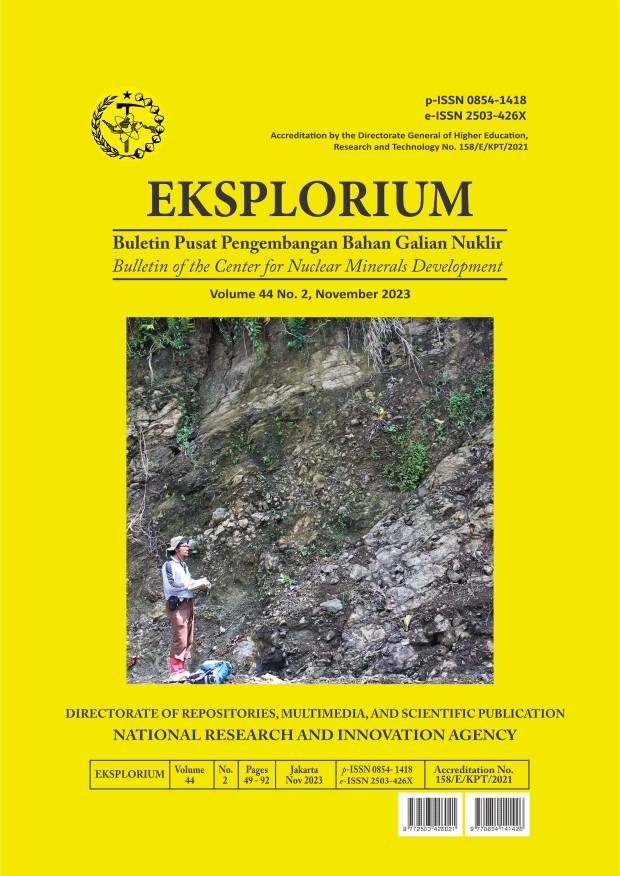
Eksplorium Buletin Pusat Pengembangan Geologi Nuklir


Eksplorium adalah media informasi Buletin Pusat Pengembangan Geologi Nuklir, ter akreditasi LIPI No.352/Akred-LIPI/P2MBI/07/2011
Diterbitkan oleh Pusat Pengembangan Geologi Nuklir- BATAN
Lihat Jurnal | Terbitan Terkini | Daftar


Logo Header Halaman


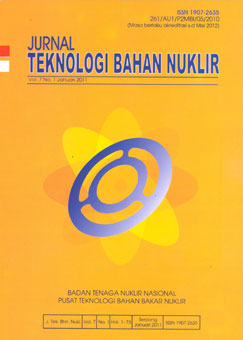
Jurnal Teknologi Bahan Nuklir


Jurnal Teknologi Bahan Nuklir, Alamat Redaksi : Penerbit Pusat Teknologi Bahan Bakar Nuklir - BATAN, Kawasan Puspiptek Serpong - Tangerang Selatan 15314, Indonesia
Lihat Jurnal | Terbitan Terkini | Daftar


Logo Header Halaman

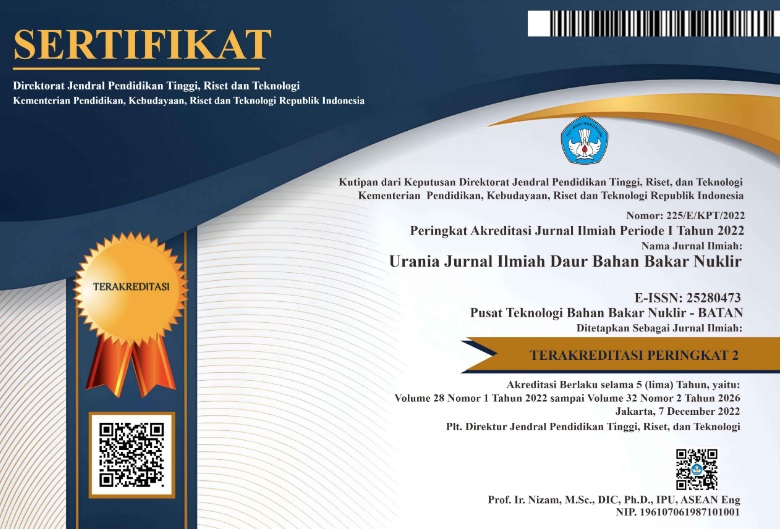
Urania Jurnal Ilmiah Daur Bahan Bakar Nuklir


Jurnal Ilmiah Daur Bahan Bakar Nuklir URANIA adalah wahana informasi tentang daur bagan bakar nuklir yang berisi hasil penelitian, pengembangan dan tulisan ilmiah terkait. terbitan pertama kali pada tahun 1995 dengan frekuensi terbit sebanyak empat kali dalam setahun yakni pada bulan Januari, April, Juli dan Oktober.

Sementara itu, mulai tahun 2011 Jurnal Daur Bahan Bakar Nuklir URANIA akan terbit tiga kali dalam setahun, yaitu Februari, Juni dan Oktober.

Lihat Jurnal | Terbitan Terkini | Daftar


Bila kita mampu membangun himpunan-himpunan peneliti kecil di tiap sekolah tinggi/kampus di Indonesia mengenai Iptek Nuklir ini, kemungkinan besar percepatan perkembangan ilmu pengetahuan Nuklir di tanah air akan semakin dahsyat dan masyarakat kita di kemudian hari dapat memetik manfaatnya.

Amin.


Sumber: Badan Tenaga Nuklir Nasional


Kunjungi juga:

http://www.batan.go.id/  (BATAN)

http://www.iaea.org/ (International Atomic Energy Agency)

http://nuclearscienceandtechnology.blogspot.com/  (Sekolah Sains dan Teknologi Nuklir)

http://masyarakatipteksindonesia.blogspot.com/2010/02/nuklir-indonesia_8979.html (Masyarakat Nuklir Indonesia)

http://www.sttn-batan.ac.id/ (Sekolah Tinggi Teknologi Nuklir BATAN)

http://ocw.mit.edu/courses/nuclear-engineering/ (Nuclear Engineering OpenCourseWare from MIT)

http://fisika.upi.edu/ (Jurusan Pendidikan Fisika, FPMIPA Universitas Pendidikan Indonesia)


Ucapan Terima Kasih Kepada:

Kak Rezy Pradipta, Ph.D. (Alumni Tim Olimpiade Fisika Indonesia, Belajar di Department of Nuclear Engineering at MIT)

Dr. Mohamed Mustafa ElBaradei, J.S.D. (Former Director General of IAEA)

Prof. Mujid S. Kazimi, Ph.D. (Director, Center for Advanced Nuclear Energy Systems MIT)

Prof.Djarot Sulistio Wisnubroto, M.Sc., D.Sc. (Presiden BATAN)

Kak Iqbal Robiyana, S.Pd. (Founder Center for Nuclear Education at Indonesia University of Education)

Dr. Petros Aslanyan, M.Sc. (Joint Institute for Nuclear Research, Rusia & Yerevan State University)

Semangat Semoga Bermanfaat

Monday, 15 August 2011

Para Pelopor Peraih Hadiah Nobel

First Prizes

Wilhelm Conrad Röntgen received the first Physics Prize for his discovery of X-rays.

Once the Nobel Foundation and its guidelines were in place, the Nobel Committees began collecting nominations for the inaugural prizes. Subsequently they sent a list of preliminary candidates to the prize-awarding institutions.

Originally, the Norwegian Nobel Committee appointed prominent figures including Jørgen Løvland, Bjørnstjerne Bjørnson and Johannes Steen to give the Nobel Peace Prize credibility.

The committee awarded the Peace Prize to two prominent figures in the growing peace movement around the end of the 19th century. These were Frédéric Passy, co-founder of the Inter-Parliamentary Union, and Henry Dunant the founder of the International Committee of the Red Cross
The Nobel Committee's Physics Prize shortlist cited Wilhelm Conrad Röntgen's discovery of X-rays and Philipp Lenard's work on cathode rays. The Academy of Sciences selected Röntgen for the prize.

In the last decades of the 19th century, many chemists had made significant contributions. Thus, with the Chemistry Prize, the Academy "was chiefly faced with merely deciding the order in which these scientists should be awarded the prize."

The Academy received 20 nominations, eleven of them for Jacobus van't Hoff. Van't Hoff was awarded the prize for his contributions in chemical thermodynamics. The Swedish Academy chose the poet Sully Prudhomme for the first Nobel Prize in Literature. 

A group including 42 Swedish writers, artists and literary critics protested against this decision, having expected Leo Tolstoy to win. Some, including Burton Feldman, have criticised this prize because they consider Prudhomme a mediocre poet. Feldman's explanation is that most of the Academy members preferred Victorian literature and thus selected a Victorian poet.

The first Physiology or Medicine Prize went to the German physiologist and microbiologist Emil von Behring. During the 1890s, von Behring developed an antitoxin to treat diphtheria, which until then was causing thousands of deaths each year.

Sumber:

Nobel Prize

Wikipedia