Thursday, 24 July 2008

Atmosphere

An atmosphere (New Latin atmosphaera, created in the 17th century from Greek ἀτμός [atmos] "vapor" and σφαῖρα [sphaira] "sphere") is a layer of gases that may surround a material body of sufficient mass, and that is held in place by the gravity of the body. An atmosphere may be retained for a longer duration, if the gravity is high and the atmosphere's temperature is low. Some planets consist mainly of various gases, but only their outer layer is their atmosphere.

The term stellar atmosphere describes the outer region of a star, and typically includes the portion starting from the opaque photosphere outwards. Relatively low-temperature stars may form compound molecules in their outer atmosphere. Earth's atmosphere, which contains oxygen used by most organisms for respiration and carbon dioxide used by plants, algae and cyanobacteria for photosynthesis, also protects living organisms from genetic damage by solar ultraviolet radiation. Its current composition is the product of billions of years of biochemical modification of the paleoatmosphere by living organisms.

Sunday, 20 July 2008

Indonesian Space Tourism Society

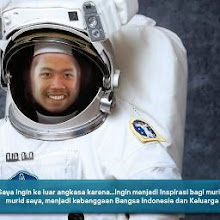
Space tourism is the recent phenomenon of tourists paying for flights into space pioneered by Russia.
As of 2008, orbital space tourism opportunities are limited and expensive, with only the Russian Space Agency providing transport. The price for a flight brokered by Space Adventures to the International Space Station aboard a Soyuz spacecraft is now $20 million. Flights are fully booked until 2009.
Among the primary attractions of space tourism are the uniqueness of the experience, the thrill and awe of looking at Earth from space, the experience's notion as an exclusive status symbol, and various advantages of weightlessness. The space tourism industry is being targeted by spaceports in numerous locations, including California, Oklahoma, New Mexico, Florida, Virginia, Alaska, Wisconsin, Esrange in Sweden as well as the United Arab Emirates. Some use the term "personal spaceflight" as in the case of the Personal Spaceflight Federation.

Contents

Friday, 18 July 2008

Theoretical Astrophysics

Add and Edited By:
Arip Nurahman
Indonesia University of Education
and
Follower Open Course Ware at Massachusetts Institute of Technology, Cambridge.
USA


from: Wikipedia International


Astrophysics is the branch of astronomy that deals with the physics of the universe, including the physical properties (luminosity, density, temperature, and chemical composition) of celestial objects such as stars, galaxies, and the interstellar medium, as well as their interactions. The study of cosmology is theoretical astrophysics at scales much larger than the size of particular gravitationally-bound objects in the universe.

Because astrophysics is a very broad subject, astrophysicists typically apply many disciplines of physics, including mechanics, electromagnetism, statistical mechanics, thermodynamics, quantum mechanics, relativity, nuclear and particle physics, and atomic and molecular physics. In practice, modern astronomical research involves a substantial amount of physics.

The name of a university's department ("astrophysics" or "astronomy") often has to do more with the department's history than with the contents of the programs. Astrophysics can be studied at the bachelors, masters, and Ph.D. levels in aerospace engineering, physics, or astronomy departments at many universities.

Contents


Founded in 1983, the Fermilab Theoretical Astrophysics Group consists of approximately 15 theoretical astrophysicists who perform research at the confluence of astrophysics, cosmology, and particle physics. The group is partially funded by a NASA Astrophysics Theory grant. Since its inception, the group has prepared over 1000 papers for publication.

Fermi National Laboratory

Theoretical Astrophysics
People
Alumni
Visitors
Projects
Events
Internal

Image1
Image2


Wilson Hall 6 West
Fermilab, P.O. Box 500
Batavia, IL 60510, USA

Phone (630) 840-3758
Fax (630) 840-8231

Security, Privacy, Legal
Office of Science
Image3
Searching for Strong Lenses ...
workshop @ Fermilab June 13-14, 2007.

Our weekly journal club or Munch takes place every Monday at 12:30PM in the conference room on 6W. Join us!
Welcome to the Theoretical Astrophysics Center at the University of California, Berkeley
The Theoretical Astrophysics Center includes faculty, research scientists, postdoctoral researchers, and students working on a wide variety of problems in theoretical astrophysics. Our specialties include cosmology, planetary dynamics, the interstellar medium, star and planet formation, and compact objects. If you have any questions, feel free to contact anyone in our group by email. If you have a general inquiry, however, please first try Natasha Singh, the TAC's Administrative Assistant, at natasha@astro.berkeley.edu.


Visitor Information
Maps, Housing, Environs
Links
Astronomy Department
Physics Department
Center for Theoretical Physics
Center for Integrative Planetary Science


Lihat Juga: