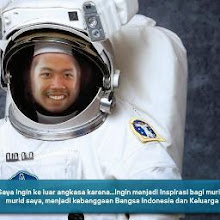
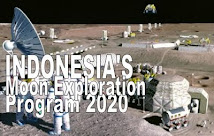
Sekolah Sains dan Teknologi Antariksa & Kedirgantaraan Indonesia
SST-AKI
Indonesian Space Sciences Technology School

SST-AKI
Indonesian Space Sciences Technology School


Vision
"Experiments In The Cosmos, Because Our Laboratory is Universe"
Mission
1. Menjadi Sekolah Teknologi Cyber Keantariksaan dan Kedirgantaraan Terdepan di Indonesia
2. Melahirkan Generasi Impian yang Selalu Bertafakur, Bertadabur dan Bertasayakur terhadap Keseimbangan Semesta yang Telah Tercipta
My Open Course Ware at Department of Aeronautics and Astronautics Massachusetts Institute of Technology, Cambridge M.A., USA
Professors, students, and researchers come to MIT from all corners of the globe to explore their passion for air and space travel and to advance the technologies and vehicles that make such travel possible.
We build on our long tradition of scholarship and research to develop and implement reliable, safe, economically feasible, and environmentally responsible air and space travel.
Our industry contributions and collaborations are extensive. We have graduated more astronauts than any other private institution in the world. Nearly one-third of our current research collaborations are with MIT faculty in other departments, and approximately one-half are with non-MIT colleagues in professional practice, government agencies, and other universities. We work closely with scientists and scholars at NASA, Boeing, the U.S. Air Force, Stanford University, Lockheed Martin, and the U.S. Department of Transportation.
Our educational programs are organized around three overlapping areas:
Aerospace information engineering
Focuses on real-time, safety-critical systems with humans-in-the-loop. Core disciplines include autonomy, software, communications, networks, controls, and human-machine and human-software interaction.
Focuses on real-time, safety-critical systems with humans-in-the-loop. Core disciplines include autonomy, software, communications, networks, controls, and human-machine and human-software interaction.
Aerospace systems engineering
Explores the central processes in the creation, implementation, and operation of complex socio-technical engineering systems. Core disciplines include system architecture and engineering, simulation and modeling, safety and risk management, policy, economics, and organizational behavior.
Explores the central processes in the creation, implementation, and operation of complex socio-technical engineering systems. Core disciplines include system architecture and engineering, simulation and modeling, safety and risk management, policy, economics, and organizational behavior.
Aerospace vehicles engineering
Addresses the engineering of air and space vehicles, their propulsion systems, and their subsystems. Core disciplines include fluid and solid mechanics, thermodynamics, acoustics, combustion, controls, computation, design, and simulation.
Addresses the engineering of air and space vehicles, their propulsion systems, and their subsystems. Core disciplines include fluid and solid mechanics, thermodynamics, acoustics, combustion, controls, computation, design, and simulation.
Department of Aeronautics and Astronautics links
Visit the MIT Department of Aeronautics and Astronautics home page at:
http://web.mit.edu/aeroastro/www/
http://web.mit.edu/aeroastro/www/
Review the MIT Department of Aeronautics and Astronautics curriculum at:
http://ocw.mit.edu/OcwWeb/web/resources/curriculum/index.htm#16
http://ocw.mit.edu/OcwWeb/web/resources/curriculum/index.htm#16
Learn more about MIT Engineering:
http://engineering.mit.edu/
http://engineering.mit.edu/
- Astrophysics and Aerospace Engineering (Teknik Penerbangan Luar Angkasa)
- Division of Fluid Mechanics
- Division of Orbital Mechanics
- Division of Aerospace Engineering Analysis in Other Nations
- Fluid mechanics - the study of fluid flow around objects. Specifically aerodynamics concerning the flow of air over bodies such as wings or through objects such as wind tunnels (see also lift and aeronautics).
- Astrodynamics - the study of orbital mechanics including prediction of orbital elements when given a select few variables. While few schools in the United States teach this at the undergraduate level, several have graduate programs covering this topic (usually in conjunction with the Physics department of said college or university).
- Statics and Dynamics (engineering mechanics) - the study of movement, forces, moments in mechanical systems.
- Mathematics - because aerospace engineering heavily involves mathematics.
- Electrotechnology - the study of electronics within engineering.
- Propulsion - the energy to move a vehicle through the air (or in outer space) is provided by internal combustion engines, jet engines and turbomachinery, or rockets (see also propeller and spacecraft propulsion). A more recent addition to this module is electric propulsion and ion propulsion.
- Control engineering - the study of mathematical modeling of the dynamic behavior of systems and designing them, usually using feedback signals, so that their dynamic behavior is desirable (stable, without large excursions, with minimum error). This applies to the dynamic behavior of aircraft, spacecraft, propulsion systems, and subsystems that exist on aerospace vehicles.
- Aircraft structures - design of the physical configuration of the craft to withstand the forces encountered during flight. Aerospace engineering aims to keep structures lightweight.
- Materials science - related to structures, aerospace engineering also studies the materials of which the aerospace structures are to be built. New materials with very specific properties are invented, or existing ones are modified to improve their performance.
- Solid mechanics - Closely related to material science is solid mechanics which deals with stress and strain analysis of the components of the vehicle. Nowadays there are several Finite Element programs such as MSC Patran/Nastran which aid engineers in the analytical process.
- Aeroelasticity - the interaction of aerodynamic forces and structural flexibility, potentially causing flutter, divergence, etc.
- Avionics - the design and programming of computer systems on board an aircraft or spacecraft and the simulation of systems.
- Risk and reliability - the study of risk and reliability assessment techniques and the mathematics involved in the quantitative methods.
- Noise control - the study of the mechanics of sound transfer.
- Flight test - designing and executing flight test programs in order to gather and analyze performance and handling qualities data in order to determine if an aircraft meets its design and performance goals and certification requirements.
The basis of most of these elements lies in theoretical mathematics, such as fluid dynamics for aerodynamics or the equations of motion for flight dynamics. However, there is also a large empirical component. Historically, this empirical component was derived from testing of scale models and prototypes, either in wind tunnels or in the free atmosphere. More recently, advances in computing have enabled the use of computational fluid dynamics to simulate the behavior of fluid, reducing time and expense spent on wind-tunnel testing.
Additionally, aerospace engineering addresses the integration of all components that constitute an aerospace vehicle (subsystems including power, aerospace bearings, communications, thermal control, life support, etc.) and its life cycle (design, temperature, pressure, radiation, velocity, life time).
Aerospace engineering degrees
See also: List of aerospace engineering schools
Aerospace (or aeronautical) engineering can be studied at the advanced diploma, bachelor's, master's, and Ph.D. levels in aerospace engineering departments at many universities, and in mechanical engineering departments at others. A few departments offer degrees in space-focused astronautical engineering. The programs of the Massachusetts Institute of Technology and Rutgers University are two such examples. U.S. News & World Report ranks the aerospace engineering programs at the Massachusetts Institute of Technology, Georgia Institute of Technology, and the University of Michigan within the top three best programs for doctorate granting universities. However, other top programs within the ten best in the United States include those of Stanford University, Texas A&M University, the University of Texas at Austin, Purdue University and the University of Illinois.[11] The magazine also rates Embry-Riddle Aeronautical University, and United States Air Force Academy as the premier aerospace engineering programs at universities that do not grant doctorate degrees.
In the UK, Aerospace (or aeronautical) engineering can be studied for the B.Eng., M.Eng.,MSc. and Ph.D. levels at a number of universities. The top universities include University of Cambridge, Imperial College London, University of Sheffield, University of Glasgow, Cranfield University, University of Bristol, University of Bath, University of Manchester and the University of Southampton . Particularly the Department of Aeronautics at Imperial College London is famous for providing engineers for the Formula One industry, an industry that uses aerospace technology.
See also
- List of aerospace engineering topics
- List of aerospace engineers
- American Institute of Aeronautics and Astronautics
- Sigma Gamma Tau (aerospace engineering honor society)
- Flight test
- MIT OpenCourseWare at Aero & Astro Engineering
- Curriculum at Department of Aeronautics and Astronautics
- Introduction to Aerospace Engineering and Design Spring 2003
- Unified Engineering I, II, III, & IV Fall 2005
- Unified Engineering I, II, III, & IV Fall 2005
- Unified Engineering I, II, III, & IV Fall 2005
- Unified Engineering I, II, III, & IV Fall 2005
- Thermal Energy Fall 2002
- Principles of Automatic Control Fall 2003
- Dynamics Fall 2004
- Aerodynamics Fall 2005
- Structural Mechanics Fall 2002
- Techniques for Structural Analysis and Design Spring 2005
- Estimation and Control of Aerospace Systems Spring 2004
- Communication Systems Engineering Spring 2003
- Principles of Autonomy and Decision Making Fall 2005
- Principles of Autonomy and Decision Making Fall 2005
- Aerospace Dynamics Spring 2003
- Experimental Projects I Spring 2003
- Experimental Projects II Fall 2003
- Inventions and Patents Fall 2005
- Management in Engineering Fall 2004
- Introduction to Lean Six Sigma Methods January (IAP) 2008
- Prototyping Avionics Spring 2006
- Engineering Design and Rapid Prototyping January (IAP) 2005
- Engineering Design and Rapid Prototyping January (IAP) 2007
- The Aerospace Industry Spring 2004
- Space Systems Engineering Spring 2002
- Introduction to Lean Six Sigma Methods January (IAP) 2008
- Computational Methods in Aerospace Engineering Spring 2005
Course Title Term
1. Compressible Flow Spring 2003
2. Aerodynamics of Viscous Fluids Fall 2003
3. Computational Mechanics of Materials Fall 2003
4. Plates and Shells Spring 2007
5. Feedback Control Systems Fall 2007
6. Stochastic Estimation and Control Fall 2004
7. Principles of Optimal Control Spring 2008
8. Aircraft Stability and Control Fall 2004
9. Dynamics of Nonlinear Systems Fall 2003
10. Astrodynamics Fall 2008
11. Software Engineering Concepts Fall 2005
12. System Safety Spring 2005
13. Data Communication Networks Fall 2002
14. Infinite Random Matrix Theory Fall 2004
15. Random Matrix Theory and Its Applications Spring 2004
16. Principles of Autonomy and Decision Making Fall 2005
17. Cognitive Robotics Spring 2005
18. Principles of Autonomy and Decision Making Fall 2005
19. Human Supervisory Control of Automated Systems Spring 2004
20. Aerospace Biomedical and Life Support Engineering Spring 2006
21. Biomedical Signal and Image Processing Spring 2007
22. Rocket Propulsion Fall 2005
23. Space Propulsion Spring 2004
24. Internal Flows in Turbomachines Spring 2006
25. Introduction to Lean Six Sigma Methods January (IAP) 2008
26. Air Traffic Control Fall 2006
27. Airline Management Spring 2006
28. Logistical and Transportation Planning Methods Fall 2004
29. Logistical and Transportation Planning Methods Fall 2006
30. Airline Schedule Planning Spring 2003
31. Satellite Engineering Fall 2003
32. Integrating the Lean Enterprise Fall 2005
33. Introduction to Lean Six Sigma Methods January (IAP) 2008
34. Engineering Systems Analysis for Design Fall 2008
35. Engineering Risk-Benefit Analysis Spring 2007
36. System Safety Spring 2005
37. Robust System Design Summer 1998
38. Aircraft Systems Engineering Fall 2004
40. Aircraft Systems Engineering Fall 2005
41. Air Transportation Systems Architecting Spring 2004
42. Multidisciplinary System Design Optimization Spring 2004
43. Space Policy Seminar Spring 2003
44. Space System Architecture and Design Fall 2004
45. Engineering Apollo: The Moon Project as a Complex System Spring 2007
46. Space Systems Engineering Spring 2007
47. Introduction to Numerical Simulation (SMA 5211) Fall 2003
48. Numerical Methods for Partial Differential Equations (SMA 5212) Spring 2003
49. Computational Geometry Spring 2003
50. Proseminar in Manufacturing Fall 2005
1. Compressible Flow Spring 2003
2. Aerodynamics of Viscous Fluids Fall 2003
3. Computational Mechanics of Materials Fall 2003
4. Plates and Shells Spring 2007
5. Feedback Control Systems Fall 2007
6. Stochastic Estimation and Control Fall 2004
7. Principles of Optimal Control Spring 2008
8. Aircraft Stability and Control Fall 2004
9. Dynamics of Nonlinear Systems Fall 2003
10. Astrodynamics Fall 2008
11. Software Engineering Concepts Fall 2005
12. System Safety Spring 2005
13. Data Communication Networks Fall 2002
14. Infinite Random Matrix Theory Fall 2004
15. Random Matrix Theory and Its Applications Spring 2004
16. Principles of Autonomy and Decision Making Fall 2005
17. Cognitive Robotics Spring 2005
18. Principles of Autonomy and Decision Making Fall 2005
19. Human Supervisory Control of Automated Systems Spring 2004
20. Aerospace Biomedical and Life Support Engineering Spring 2006
21. Biomedical Signal and Image Processing Spring 2007
22. Rocket Propulsion Fall 2005
23. Space Propulsion Spring 2004
24. Internal Flows in Turbomachines Spring 2006
25. Introduction to Lean Six Sigma Methods January (IAP) 2008
26. Air Traffic Control Fall 2006
27. Airline Management Spring 2006
28. Logistical and Transportation Planning Methods Fall 2004
29. Logistical and Transportation Planning Methods Fall 2006
30. Airline Schedule Planning Spring 2003
31. Satellite Engineering Fall 2003
32. Integrating the Lean Enterprise Fall 2005
33. Introduction to Lean Six Sigma Methods January (IAP) 2008
34. Engineering Systems Analysis for Design Fall 2008
35. Engineering Risk-Benefit Analysis Spring 2007
36. System Safety Spring 2005
37. Robust System Design Summer 1998
38. Aircraft Systems Engineering Fall 2004
40. Aircraft Systems Engineering Fall 2005
41. Air Transportation Systems Architecting Spring 2004
42. Multidisciplinary System Design Optimization Spring 2004
43. Space Policy Seminar Spring 2003
44. Space System Architecture and Design Fall 2004
45. Engineering Apollo: The Moon Project as a Complex System Spring 2007
46. Space Systems Engineering Spring 2007
47. Introduction to Numerical Simulation (SMA 5211) Fall 2003
48. Numerical Methods for Partial Differential Equations (SMA 5212) Spring 2003
49. Computational Geometry Spring 2003
50. Proseminar in Manufacturing Fall 2005
- Collaborative Writing and Project with International Students Over the World
- 1
- 2
- 3
- 4
| Educational Resources from ITB |
Bahan-bahan kuliah di bawah ini sebagian besar didanai dari proyek hibah PHK-A2. Silakan diakses.
Silakan dimanfaatkan beberapa taut berikut yang juga disusun oleh staf:
Arsip kuliah
Arsip ujianCopyright © 2008 Institut Teknologi Bandung |
Banjar Astro Physics Association (Kembali Ke Rumah Home)
Administrator:
Arip Nurahman & Anton Timur Jaelani